
Key Takeaways
- Indian suppliers win on small runs, urgent re-orders and rupee invoicing: directory listings show plain PP airless bottles from roughly ₹24 per piece with no import paperwork.
- Importing from China wins on range, decoration and consistency at volume: a worked example of 15,000 pcs (3 SKUs × 5,000) lands at about ₹35.5–40 per piece before GST, depending on whether AIDC applies, so the reason to import is choice and finish, not a dramatically lower price on basic bottles.
- Plan about 6–8 weeks from sample approval to your warehouse when importing: about 15 days production, roughly 13–22 days sea freight Ningbo to Nhava Sheva, plus trucking, LCL handling and customs clearance.
Last updated: 2026-11-14. Written by the export team at Yuyao Hongye Commodity Co., a cosmetic packaging factory in Yuyao, China — so we are one of the options compared here. We have tried to say plainly when a local Indian supplier is the better choice.
Quick answer
Buy from an Indian airless bottle manufacturer if you need fewer than about 5,000 pieces per design, need re-orders within two weeks, or want to pay in rupees without import paperwork. Import from a Chinese factory if you need many sizes and finishes from one source, decorated bottles (printing, hot stamping, metallized collars), matching jars and pumps, or consistent quality across 5,000+ piece runs — and you can plan about 6–8 weeks ahead.
On plain bottles the landed price is close. In our worked example below, an imported, printed 30 ml airless bottle lands at roughly ₹35.5–40 per piece before GST; Indian directory listings for plain stock bottles start around ₹24. The real differences are range, finish, consistency and lead time.
Who makes airless pump bottles in India?
Indian supply falls into three groups:
| Supplier type | Examples | What to expect |
|---|---|---|
| Global dispensing companies present in India | Market reports name Aptar Pharma India, Albéa Betts India and Silgan Dispensing Systems India (TechSci Research) | Premium systems, higher price and higher MOQ; ask which items are made in India |
| Domestic plastic converters | Sarvottam Polymers, Mumbai (est. 1996, also imports airless bottles) (ensun); Zenvista Packagings (company blog) | Standard PP/AS bottles, faster local delivery, smaller MOQs |
| Directory suppliers and traders | Listings on IndiaMART and ExportersIndia (Delhi, Vasai and other clusters) | Low MOQ, wide price spread; many resell imported stock |
Directory prices give a rough benchmark: 15, 30 and 50 ml PP airless bottles listed from about ₹24 per piece, and airless cosmetic bottles from Delhi suppliers at about ₹40–60 per piece (listed prices for stock items, late 2026; a quote for your size, color and print will differ).
Before you shortlist an Indian supplier, ask the same question you would ask a Chinese one: which parts are molded in your own plant? Airless bottles have five or six components (outer bottle, piston, base, pump, collar, overcap). A supplier who molds only the outer bottle and buys pumps is fine — but you should know who controls the part that fails most often, which is the pump.
Local or import: seven factors compared
| Factor | Indian manufacturer | Importing from China (e.g. Yuyao/Ningbo cluster) |
|---|---|---|
| Minimum order | Often a few hundred to 2,000 pcs | Usually 5,000 pcs per model (Hongye: 5,000) |
| Unit price, 30 ml PP | From ~₹24 listed (plain stock) | ~₹35.5–40 landed in our example (printed, before GST) |
| Range | Mostly standard PP/AS round bottles | Dozens of series: AS, PP, mono-material PP, acrylic, refillable, metallized, bamboo/aluminum shells, matching jars |
| Decoration | Varies; often outsourced | Color matching, silk screen, hot stamping, UV coating arranged at the factory |
| Lead time to your warehouse | Days to 2 weeks | About 6–8 weeks (see timeline below) |
| Paperwork | Local GST invoice | IEC code, customs broker, bill of entry, IGST paid at clearance, plastic packaging EPR registration as importer |
| Quality evidence | Ask for test reports and audits | Ask for ISO 9001 scope, social audit, pump test data, pre-shipment inspection |
Worked example: landed cost of 15,000 airless bottles
Illustrative example with stated assumptions — not a quote. Replace each number with your real FOB price, freight quote and the current customs rate.
Order: 3 designs × 5,000 pcs of 30 ml PP airless bottles with your color and one-color print = 15,000 pcs, shipped LCL from Ningbo to Nhava Sheva (about 3–4 CBM).
| Line | Assumption | Amount |
|---|---|---|
| FOB Ningbo | US$0.30 × 15,000 pcs | US$4,500 |
| Sea freight + origin LCL charges | Forwarder quote, assumed | US$350 |
| Insurance | 1.125% of FOB (the customs valuation rule when actual insurance cost is not known) | US$51 |
| CIF value | US$4,901 | |
| Assessable value in INR | at ₹88 / US$ (use the customs-notified rate) | ₹4,31,255 |
| Basic customs duty | 15% | ₹64,688 |
| Social welfare surcharge | 10% of BCD | ₹6,469 |
| Clearance, port, DO, local delivery | Broker estimate, assumed | ₹30,000 |
| Landed cost before GST (no AIDC) | ₹5,32,412 ≈ ₹35.5 per piece | |
| If AIDC 15% also applies | +₹64,688 | ₹5,97,100 ≈ ₹39.8 per piece |
| IGST | 18% on value + duties, paid at clearance; usually claimable as input tax credit | ₹90,434–1,02,078 |
Two things move this number most: the FOB price (decorated or metallized bottles cost more, but so do they locally) and freight per piece — a 20 ft container of mixed bottles and jars brings freight per piece down sharply compared with LCL.
Duty basis: plastic bottles are commonly classified under HS 3923 30 90 and caps under 3923 50, but an assembled dispenser or separately shipped pumps may be classified differently — let your broker confirm the 8-digit code. Tariff tables list 15% basic duty and 18% IGST at the time of writing, and some also show 15% AIDC (eximpe HS lookup, Seair chapter 39). Rates change with budgets and notifications, so confirm with your broker. India and China have no free trade agreement, so a certificate of origin does not reduce the duty. Budget for working capital too: IGST is paid at the port and only recovered later as credit.
Two other India-side obligations to check: under the Plastic Waste Management Rules, importers and brand owners of plastic packaging must register for Extended Producer Responsibility (EPR) on the CPCB portal and meet collection and reporting targets — factor that cost in whichever supplier you choose. And at the time of writing we found no BIS Quality Control Order covering empty cosmetic airless bottles, but QCOs change, so ask your broker to confirm.
Timeline: deposit to your warehouse
| Step | Typical time |
|---|---|
| Sample approval and artwork | 3–7 days (stock samples ship free, freight collect) |
| Production on an existing mold, your color and printing | about 15 days |
| Special finish (metallizing, aluminum or bamboo shell) | +5–10 days |
| Trucking to Ningbo port and export clearance | 2–5 days |
| Sea freight Ningbo → Nhava Sheva | about 13–18 days direct, up to ~22 days with transshipment; Chennai and Mundra differ (Cogoport, Shipa Freight) |
| LCL deconsolidation, Indian customs clearance and delivery | 3–7 days, longer if the shipment is examined |
| Total | about 6–8 weeks |
If your launch date is fixed, order the bottles before you finalize the outer carton — packaging is usually on the critical path, not formulation.
When an Indian supplier is clearly the better choice
- You are testing a product and need 500–2,000 bottles. A 5,000-piece MOQ per design ties up cash you need for marketing.
- You re-order every few weeks in small lots and cannot hold safety stock.
- You do not have an IEC code or a customs broker yet, and your first order is small enough that the paperwork costs more than the savings.
- You need a plain, standard bottle and the local price is already in the ₹24–35 range.
When importing from China makes sense
- You need several sizes and a matching range — for example 15/30/50 ml airless bottles plus an airless jar for a cream, in one color and one print style, from one supplier.
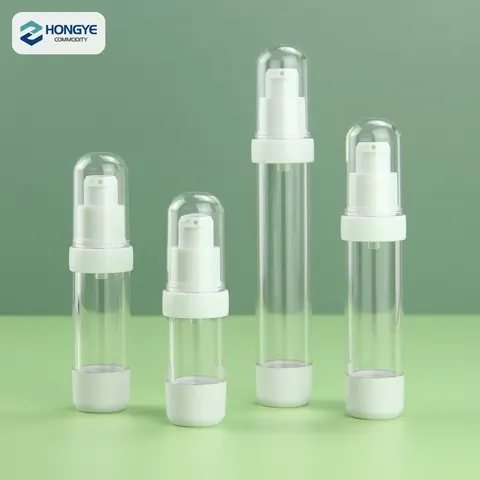
- You want a premium finish such as metallized collars, frosted AS, refillable inner cups or mono-material PP for recyclability claims. See our full-PP airless bottles and AS airless lotion bottles.
- You order 5,000+ pieces per design and care more about batch-to-batch consistency than about delivery in days.
- You are combining items into one shipment (bottles, jars, pumps, caps) to bring freight per piece down.
Six checks before you pay any supplier — Indian or Chinese
- Compatibility test with your formula. Fill 20–30 samples, store them at 40–45 °C for 4 weeks, and check for piston sticking, discoloration and weight loss. Retinol, vitamin C and high-oil serums are the usual troublemakers.
- Pump output and evacuation. Ask for dose per stroke (often 0.15–0.25 ml for 15–30 ml bottles) and test how much product remains when the pump stops — a good airless bottle should leave very little.
- Which parts are molded in-house. Ask for a video of the injection floor and the pump assembly line.
- Like-for-like quotes. Ask Indian and Chinese suppliers to quote the same size, material, pump output, color and print, with freight, duty and GST treated the same way. Otherwise a cheap stock-bottle listing will look better than it is.
- Certificates and their scope. An ISO 9001 certificate should name the products it covers and be in date. Hongye’s ISO 9001 (No. 28425Q13698R0S, valid to December 2028) covers airless bottles, cream jars, pump heads and PET bottles; our factory also passed an amfori BSCI social audit by TÜV Rheinland in December 2025.
- Pre-shipment inspection. Agree an AQL level and a short check list (leakage, pump function, print position, color against the approved sample) before production starts.
Where Hongye fits
We are a factory in Yuyao, Zhejiang — the main airless bottle cluster in China. For Indian brands the terms are the same as for every other market: MOQ 5,000 pcs per model, about 15 days production for an existing mold in your color with your printing, FOB Ningbo, and free stock samples (freight collect). We do not hold stock in India, so if you need 1,000 bottles next week, a local supplier is the better call.
If you are comparing options, send us your formula type, sizes and target quantity through the quote form and ask an Indian supplier for the same. Our airless bottle catalog lists the series we make, and our China manufacturers guide explains how to tell a factory from a trader on either side of the border. For price bands and shipping terms see the airless pump bottle wholesale guide; for custom molds and decoration see the OEM and private label guide.
Summary
For small, fast or plain orders, an Indian airless pump bottle manufacturer is usually the sensible choice. For decorated ranges, matched sets and 5,000+ piece runs, importing from a Chinese factory gives more choice at a landed price that is comparable once duty is included — provided you plan 6–8 weeks ahead and test compatibility first.
FAQ
Frequently asked questions
Who makes airless pump bottles in India?+
Three groups: global dispensing companies with Indian operations (market reports name Aptar Pharma India, Albéa Betts India and Silgan Dispensing Systems India as players in India's airless packaging market — check which products they actually make locally), domestic plastic converters such as Sarvottam Polymers in Mumbai, and many smaller suppliers and traders listed on IndiaMART and ExportersIndia. Many of the smaller listings resell imported bottles, so ask which parts are molded in-house.
Is it cheaper to import airless bottles from China to India?+
Not always. Plain PP airless bottles are listed in India from about ₹24 per piece. In our worked example, an imported 30 ml printed bottle at a US$0.30 FOB quote lands at about ₹35.5–40 per piece before GST once freight, customs duty and clearance are added. A directory listing for a plain stock bottle is not a like-for-like quote, so compare the same specification and decoration. Importing pays off when you need decoration, special finishes, matched pump-bottle-jar sets or many sizes from one supplier.
What is the import duty on plastic bottles in India?+
Plastic bottles fall under HS 3923 (3923 30 90 for bottles; 3923 50 for caps and closures). Tariff tables at the time of writing show 15% basic customs duty, a 10% social welfare surcharge, 18% IGST and — in some lookups — an additional 15% AIDC. IGST is paid at clearance and can usually be claimed as input tax credit if your business meets the GST credit conditions. Confirm the exact 8-digit code and current rates with your customs broker or on ICEGATE before you budget.
What MOQ should I expect from a Chinese airless bottle factory?+
Typically 5,000–10,000 pcs per model and color on existing molds. Hongye's MOQ is 5,000 pcs per model for Indian buyers, the same as for every other market. New molds are only economical at much higher volumes.
How long does shipping from Ningbo to Nhava Sheva take?+
Carrier and forwarder data put port-to-port sea transit at roughly 13–18 days on direct services and up to about 22 days with transshipment; Chennai and Mundra schedules differ. Add 2–5 days for trucking and export clearance in China and 3–7 days for Indian customs clearance and delivery.