
Key Takeaways
- An airless pump jar replaces the cream you dispense with a rising piston, not with outside air. It cuts repeated air exposure; it does not make the pack oxygen-free or replace preservative testing.
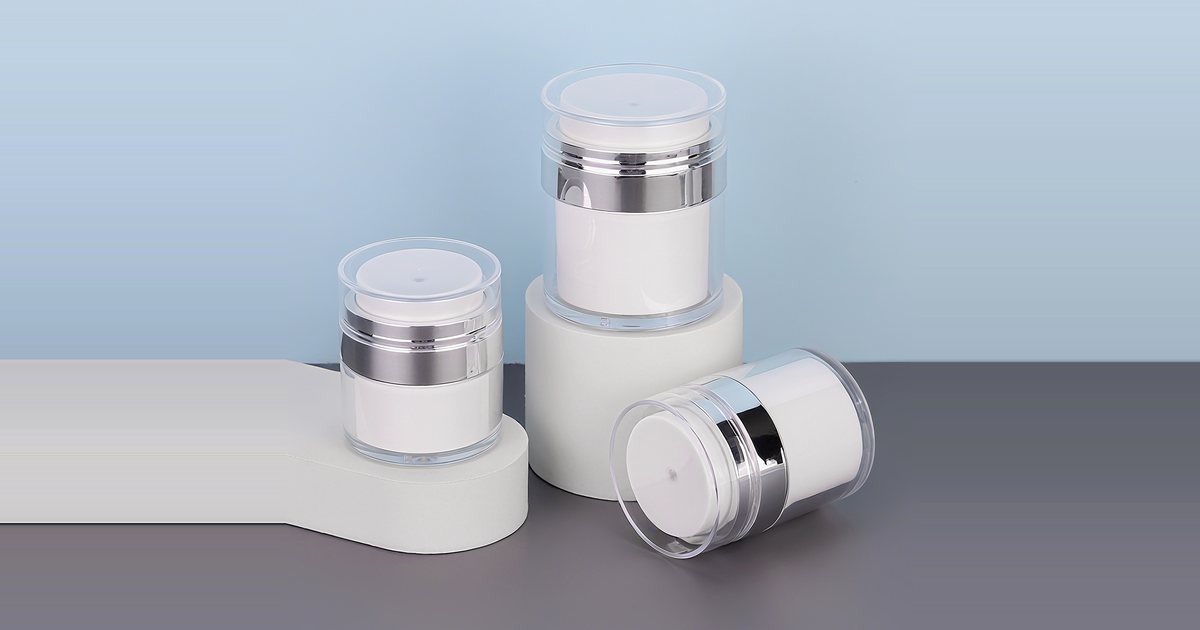
- Our HY-W018 acrylic + PP airless jar comes in 15g, 30g and 50g, measuring 54 × 62 mm, 54 × 72 mm and 62 × 75.5 mm, with empty unit weights of 65.8g, 73.8g and 97.4g.
- At the 5,000 pcs MOQ, the empty jars alone weigh about 329 kg (15g), 369 kg (30g) or 487 kg (50g), before cartons. Use those numbers in your landed-cost model, not the capacity on the label.
- Approve an airless jar by testing with your real formula: priming strokes, output per press and residue measured by weight. A viscosity number alone is not enough.
Quick answer
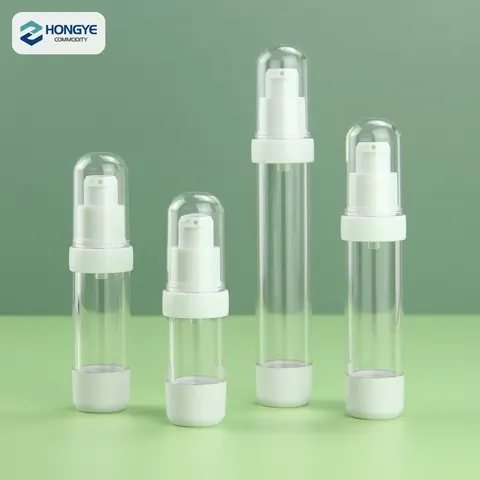
An airless pump jar is a cream jar with a press-down pump and a rising piston inside, so the cream you dispense is never replaced by outside air. For brands, the buying decisions are size (15g, 30g and 50g cover most face creams), outer material (clear acrylic for a premium look, PP for robustness and lower weight), and whether the jar dispenses your formula. Order samples, test them with your real cream, then confirm decoration and filling instructions before the production order.
This guide is written by Hongye Packaging, a cosmetic packaging factory in Yuyao, Zhejiang. The specifications below are for our own HY-W018 acrylic airless cream jar. Where we quote a figure that is an industry range rather than a measurement of our jar, we say so.
How an airless pump jar works
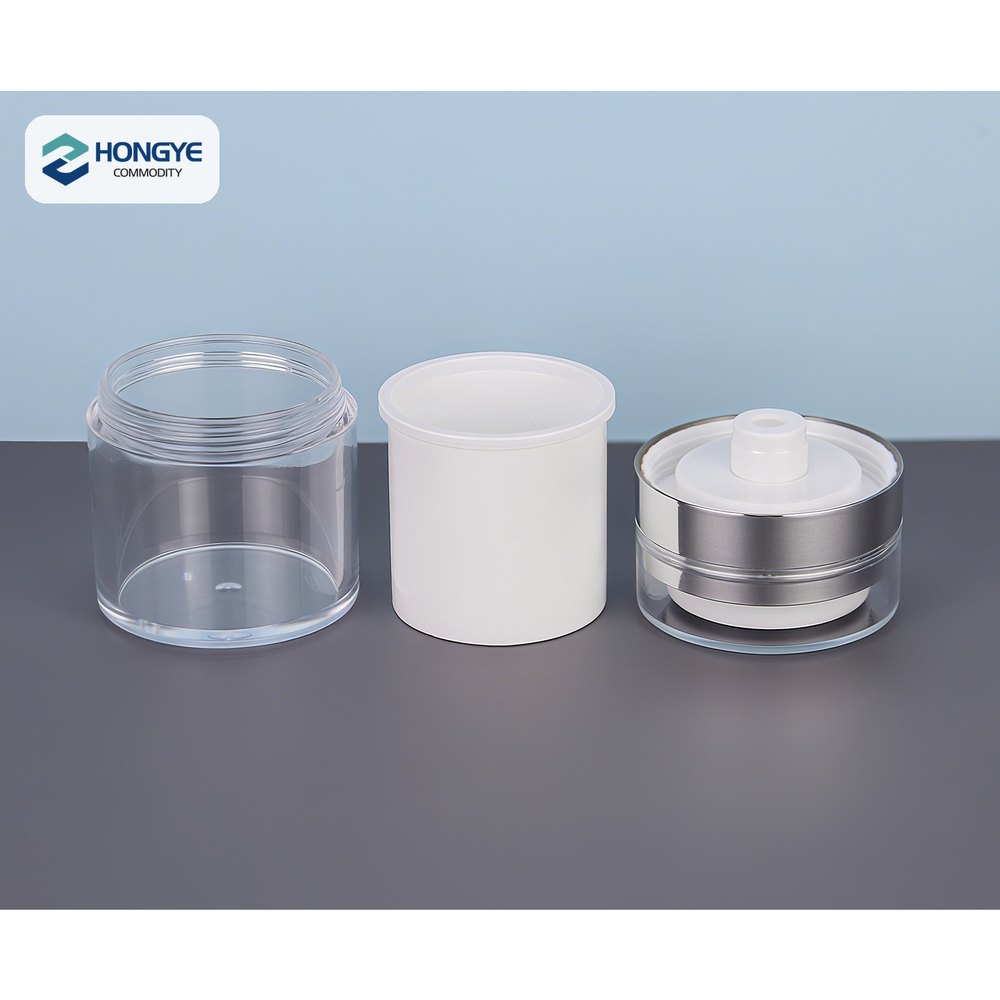
A normal cream jar is opened and scooped. A pump jar with a dip tube draws product up and lets air in to replace it. An airless jar does neither:
- Pressing the top pushes a measured amount of cream out through a one-way valve.
- The partial vacuum left behind lifts a piston (disc) at the bottom of the product chamber.
- Air enters below the piston through a vent, so it never mixes with the cream.
The result is less repeated air exposure and no fingers in the product. It is not “zero oxygen”: there is air in the headspace and in the cream itself at filling. Airless packaging supports a sensitive formula; it does not replace preservative and stability testing.
Two things buyers rarely check, and should:
- The vent. Air has to reach the space under the piston. A label, a shrink sleeve or decoration that covers the vent can stop the jar from dispensing.
- The piston start position. If the piston is not at the bottom when you fill, or is tilted during assembly, the jar may never prime properly.
Sizes and specifications: HY-W018
| Size | Diameter × height | Empty unit weight | Material | Typical use |
|---|---|---|---|---|
| 15g | 54 × 62 mm | 65.8 g | Acrylic + PP | Eye cream, travel and trial sizes |
| 30g | 54 × 72 mm | 73.8 g | Acrylic + PP | Serum-cream, day cream |
| 50g | 62 × 75.5 mm | 97.4 g | Acrylic + PP | Face cream, night cream |
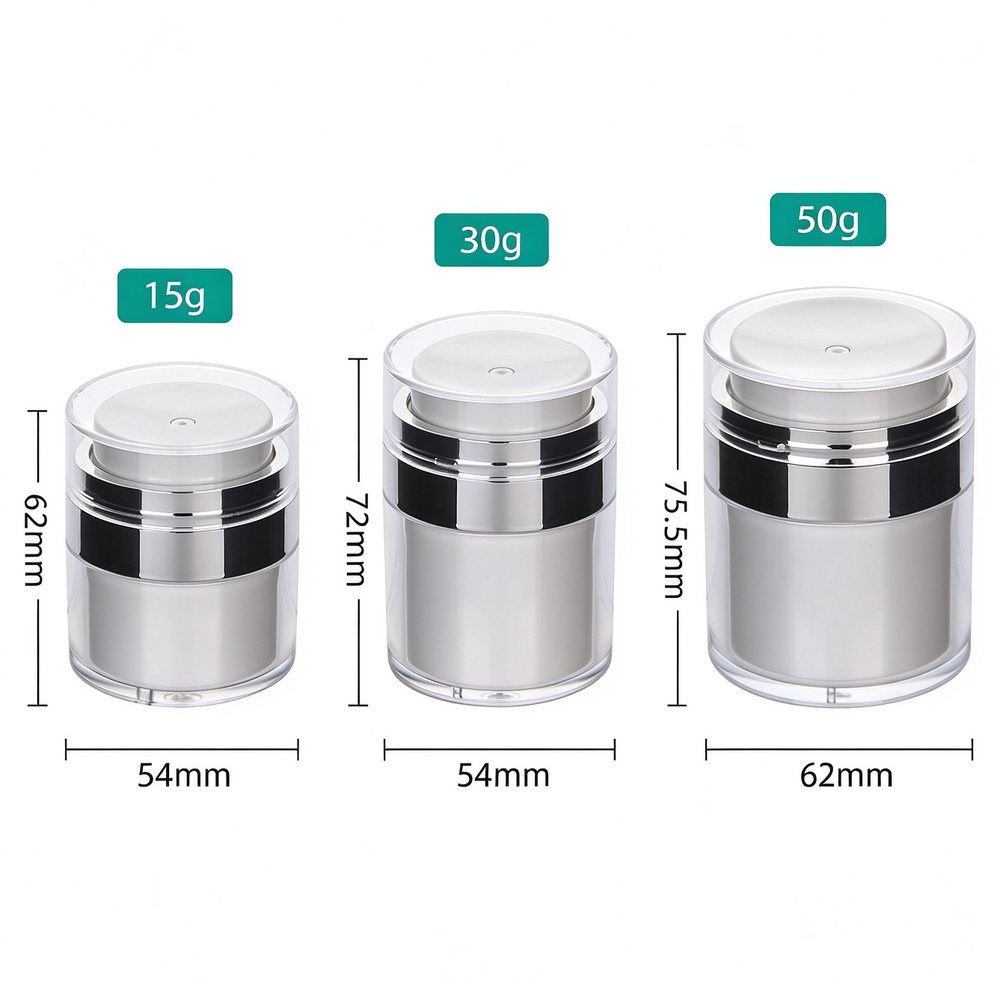
“g” is a label, not a measurement of your fill. Jars are sold as 15g / 30g / 50g, but grams are mass, not volume. How much of your cream fits depends on its density and on the fill line the filler uses. Ask for the brimful capacity and the recommended working fill, then do a fill trial before you print “50g” on the carton.
Acrylic or PP: choosing the material
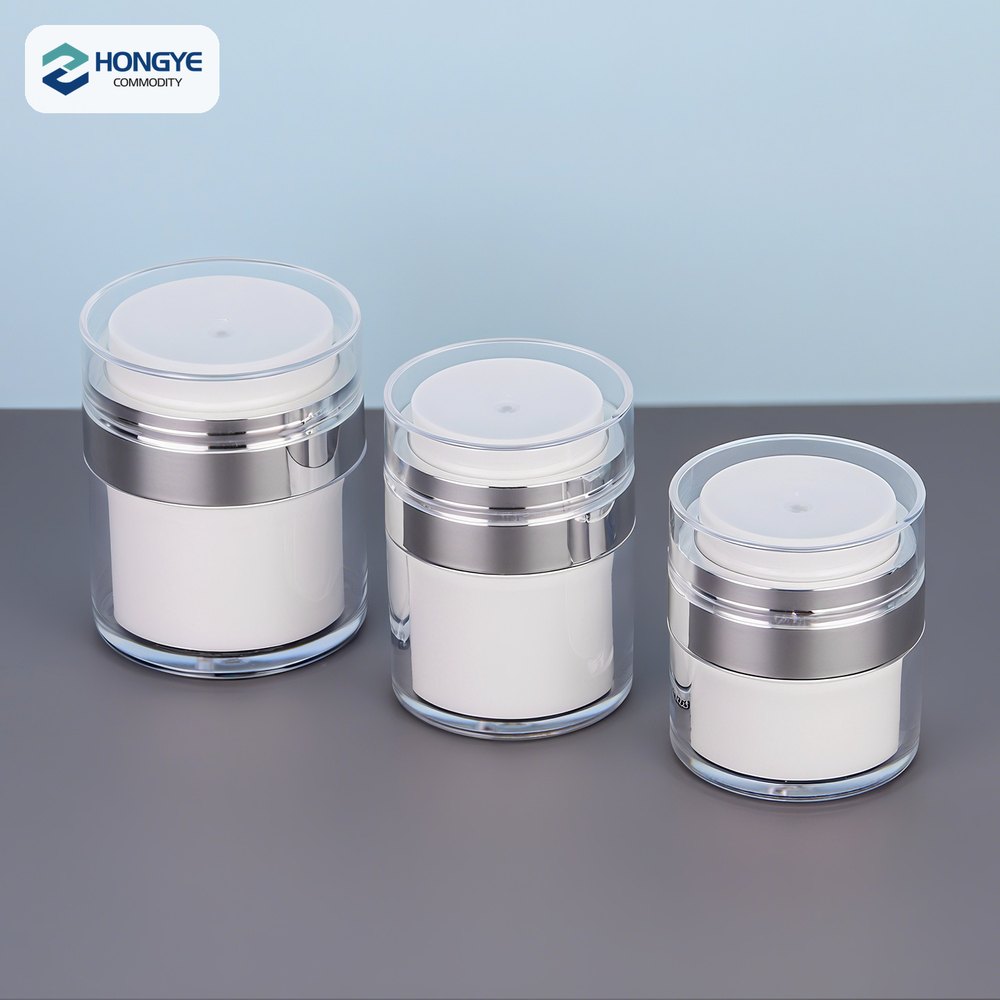
The HY-W018 uses a thick clear acrylic outer wall over PP parts. That is what gives it the weight and depth a premium cream needs on a shelf, and it is why it weighs more than an all-PP jar.
| Clear acrylic outer (e.g. HY-W018) | PP jar | |
|---|---|---|
| Look | Glass-like clarity, heavy “luxury” feel | Opaque or frosted, plain |
| Weight | Heavier: 65.8–97.4 g empty for 15–50g | Lighter |
| Chemical resistance | Can craze or crack with some oils, fragrance and solvents | Broad chemical resistance |
| Decoration | Silk screen and hot stamping look “deep” through the wall | Molded color, printing |
| Best for | Premium face and eye creams | Mass-market, oil-rich or fragrance-heavy creams |
The question that matters is which part touches the cream. Ask the factory to confirm the material of every product-contact part (chamber, piston, valve, seal), then test the complete decorated jar with your formula. Store filled samples upright, sideways and upside down for several weeks, and check for:
- crazing or cracks in the acrylic, swelling or warping of the PP parts
- leaks at the pump, sticky or slow-returning pump tops
- ink or hot stamping lifting, discoloration, odor transfer
If your cream is rich in essential oils, fragrance or solvents, a simple PP cream jar or a full-PP airless bottle may be the safer choice.
Will it dispense your formula? Four tests before you order
Category pages list sizes and colors. They rarely tell you how to check the jar actually works with your cream. Run these four tests on free samples:
- Priming. Count the presses until cream first appears, on at least 10 jars. A jar that needs far more presses than the others usually has trapped air or a piston problem.
- Output per press. Weigh 10 full presses after priming and divide by 10. Airless pumps for cosmetics commonly deliver a fraction of a milliliter per press (industry reference roughly 0.1–0.5 ml, not a specification of our jar). Your usable fill divided by the dose per use gives the number of applications on your label.
- Residue. Weigh the empty jar, then the filled jar, then the jar after it stops dispensing. Residue = what is left ÷ what you filled. Do it by weight with your production cream. A clear acrylic wall can make a jar look empty while cream remains around the valve and piston edge.
- Formula behavior. Send the factory your cream, not just a viscosity number. Two creams with similar viscosity can dispense very differently, and creams with particles, beads or a lot of air whipped in need extra testing.
If a sample does not pump, it is not always a defective pump. Common causes are insufficient priming, air trapped during filling, a piston not at its start position, a blocked vent, overfilling or a formula that is too stiff.
Want to run these tests on HY-W018? We ship free stock samples in 15g, 30g and 50g (freight collect). Tell us your formula type and target market.
Request airless jar samplesFilling and assembly: get it in writing
Some airless designs are filled from the top, others from the bottom or through an inner cup. Do not assume. Before you book a contract filler or buy nozzles, ask the factory for:
- filling direction and piston start position
- recommended fill weight per size and maximum fill level
- assembly sequence for the pump top, and any press-fit or torque requirement
- whether the cream should be de-aerated before filling
- the priming instruction you will print for consumers
Thick creams trap air easily. Filling from low in the chamber and controlling nozzle speed reduces air pockets, which are the most common cause of “dead” jars on a new filling line.
Decoration: what to print, and where
On an acrylic + PP airless jar there are several surfaces, and each takes decoration differently:
- Clear acrylic outer wall — silk screen printing and hot stamping. Artwork seen through a thick clear wall looks deeper than on a flat PP surface.
- Colored inner cup and collar — color can be molded or sprayed, and is seen through the acrylic.
- Pump top — usually a molded color.
Approve a physical decorated sample, not just a Pantone number: a color seen through clear acrylic will not match the same Pantone molded directly in PP. Ask for the printable area per size and run your compatibility test on decorated jars, because ink and foil can be the first thing to fail.
Ordering: MOQ, lead time and what 5,000 jars weigh
| Item | HY-W018 at Hongye |
|---|---|
| MOQ | 5,000 pcs per model |
| Samples | Free stock samples, freight collect |
| Custom order (existing mold, your color and printing) | ~15 days after deposit and artwork approval |
| Special finishes | +5–10 days |
| New mold | 35–45 days |
| Shipping term | FOB Ningbo |
Because acrylic jars are heavy, packaging weight is part of your cost of goods, not a detail. Using the measured unit weights:
| Size | Empty weight per jar | 5,000 jars (empty, before cartons) | Space per 5,000 jars (bounding box, before cartons) |
|---|---|---|---|
| 15g | 65.8 g | ≈ 329 kg | ≈ 0.90 m³ |
| 30g | 73.8 g | ≈ 369 kg | ≈ 1.05 m³ |
| 50g | 97.4 g | ≈ 487 kg | ≈ 1.45 m³ |
Moving from 15g to 50g adds about 158 kg of packaging per 5,000 pieces. The volume column multiplies each jar’s outside dimensions as a box; cartons, dividers and pallets add to it, and we quote exact carton data with every quotation. For more on container loading, payment terms and HS codes, see our airless pump bottle wholesale guide. If you need a new shape rather than an existing mold, read the airless OEM and private label guide.
Mistakes to avoid when ordering airless jars from China
- Approving on looks and capacity only. Approve dispensing with your real cream before the purchase order.
- Accepting an evacuation percentage copied from another supplier. Ask for a test on the actual model, or run the residue test yourself.
- Sending only a viscosity number. Send a filled sample of the formula.
- Assuming every airless jar fills the same way. Get the filling and assembly instructions for the exact model.
- Testing compatibility on undecorated jars. Test the decorated, assembled pack in all orientations.
- Leaving packaging weight out of the landed cost. At 97.4 g empty, a 50g acrylic jar can weigh nearly twice its fill.
Where to go next
- Product page and photos: HY-W018 acrylic airless cream jar
- Non-airless options, from 3g sample jars to 500g PET jars: all cream jars
- Airless bottles with lotion pumps and mist sprayers, 5–250 ml: airless bottles
Quote an airless pump jar order. Send size, quantity, decoration and formula type and we reply within 24 hours with price, carton data and lead time.
Get an airless jar quoteFAQ
Frequently asked questions
What is an airless pump jar?+
A cream jar with a press-down pump and a piston (disc) inside. Each press pushes cream out and the piston rises behind it, so the space left by the product is not refilled with outside air. It suits face creams, night creams and gel-creams that are sensitive to air exposure or contamination from fingers.
What sizes do airless pump jars come in?+
The common skincare sizes are 15g, 30g and 50g. Our HY-W018 acrylic airless jar is made in exactly those three sizes; 15g and 30g share a 54 mm diameter (62 mm and 72 mm tall) and the 50g is 62 mm wide and 75.5 mm tall.
What is the MOQ for airless jars from a Chinese factory?+
At Hongye the MOQ is 5,000 pcs per model. A custom order on the existing mold — your color and printing — ships in about 15 days after deposit and artwork approval; a new mold takes 35–45 days. Stock samples are free, freight collect.
Is an acrylic airless jar compatible with every formula?+
Not automatically. Clear acrylic gives the heavy, premium look, but formulas rich in essential oils, fragrance or solvents need a compatibility test on the complete decorated jar. Ask which part actually touches the cream and test the assembled pack, not just the resin.
How much cream is left when an airless jar stops pumping?+
It depends on the pump, the piston fit and your formula, so do not accept a percentage copied from a brochure. Weigh the empty jar, the filled jar and the jar after it stops dispensing, using your production formula, and repeat on several samples.
Are airless jars filled from the top or the bottom?+
Both designs exist. Before you book a filler, get the model's filling direction, piston start position, recommended fill weight and assembly sequence in writing from the factory, and run a filling trial with your cream.